School and Education 3D Icon Set: A Practical Evaluation
In the evolving landscape of digital design, the demand for high-quality visual assets that convey clarity and professionalism is higher than ever. For designers working on educational platforms, learning management systems, or corporate training applications, the choice of iconography can significantly impact user experience. The School and Education 3D Icon Set represents a specific category of assets designed to meet these needs through a minimalist aesthetic. This evaluation explores what this asset collection offers, its practical applications, and the considerations necessary to determine if it aligns with your specific project goals.
Understanding the Asset Collection
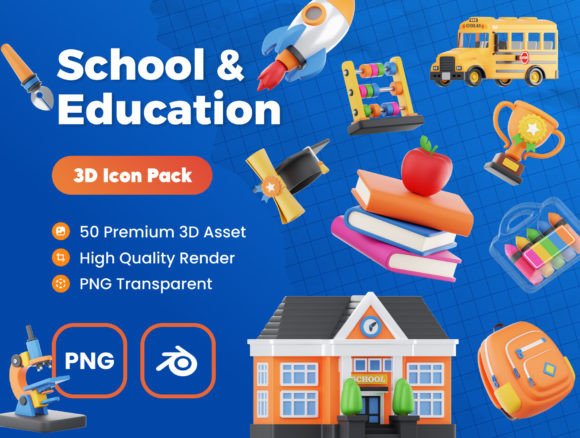
The School and Education 3D Icon Set is a curated library of three-dimensional graphical elements focused specifically on academic and learning themes. Unlike traditional flat vector icons, these assets utilize depth, lighting, and texture to create a sense of realism while maintaining a clean, modern look. The collection typically includes representations of common educational tools such as books, pencils, graduation caps, microscopes, and digital learning devices.
A defining characteristic of this set is its source format. It is provided in Blender files, which distinguishes it from standard static image packs. This means users are not limited to pre-rendered images but have access to the underlying 3D models. The set usually comprises 50 unique icons, each rendered at a high resolution of 3000x3000 pixels in PNG format for immediate use. However, the primary value proposition lies in the ability to manipulate the source files directly within the Blender environment.
Why Designers Consider 3D Educational Assets
There are several compelling reasons why a designer or product manager might evaluate this specific icon set over other options. First, the shift towards 3D interfaces in modern applications has created a need for assets that match this trend. Flat icons, while effective, can sometimes lack the visual hierarchy and engagement that 3D elements provide. In educational contexts, where capturing attention is crucial, 3D icons can make an interface feel more dynamic and approachable.
Secondly, the customization potential is a significant driver. Brand consistency is paramount for any platform. With the inclusion of fully customizable Blender files, designers can alter colors, materials, and textures to strictly adhere to brand guidelines. This flexibility ensures that the icons do not look generic but rather feel like an integral part of the application's identity. For instance, a university portal can adjust the color palette of the icons to match its official crest, while a children's learning app can apply softer, more vibrant textures.
Benefits and Practical Advantages
When integrating the School and Education 3D Icon Set into a project, several distinct advantages emerge:
- High Resolution and Scalability: The included 3000x3000 PNG images ensure that icons remain crisp on high-density displays (Retina screens) without pixelation. This is essential for modern mobile apps and web presentations.
- Full Customization Control: Access to the original Blender files allows for deep editing. Users can change lighting conditions, swap out materials, or even modify the geometry of the objects to suit specific narrative requirements.
- Visual Consistency: Since all 50 icons are created within the same workflow and style, they maintain a cohesive look. This eliminates the disjointed appearance often seen when mixing assets from different sources.
- Versatility Across Media: These assets are suitable for a wide range of deliverables, including mobile applications, web platforms, pitch decks, and marketing presentations. The 3D nature adds a layer of polish that stands out in competitive markets.
Tradeoffs and Considerations
While the benefits are clear, there are tradeoffs that must be weighed before committing to this asset type. The most significant consideration is the technical requirement. To fully leverage the customization features, the user must be proficient with Blender. If a team lacks 3D modeling expertise, the editable files may become a liability rather than an asset. In such cases, the team would be restricted to using the pre-rendered PNGs, which limits the ability to adapt the icons later if brand guidelines change.
Another factor is file size. High-resolution 3D renders and their associated source files are generally larger than simple SVG vectors. For performance-critical web applications, loading large image assets can impact page speed. While PNGs can be optimized, they still carry more weight than vector graphics. Designers must balance the visual appeal of 3D against the technical constraints of their platform.
Additionally, the "minimalist" style, while popular, may not suit every educational context. Some formal or traditional institutions may prefer more detailed, realistic illustrations or classic line art over stylized 3D objects. It is important to verify that the aesthetic of the School and Education 3D Icon Set aligns with the target audience's expectations.
Ideal Use Cases
This icon set is a strong fit for specific scenarios where visual engagement and brand alignment are priorities:
- EdTech Startups: New learning platforms often need to establish a modern, friendly brand identity quickly. The customizable nature of these icons allows startups to create a unique look without commissioning expensive custom 3D work.
- Mobile Learning Apps: Mobile interfaces benefit greatly from 3D icons due to their tactile feel and ability to draw the eye. The high resolution ensures quality on small screens.
- Corporate Training Portals: Internal LMS (Learning Management Systems) require professional yet engaging visuals. The ability to tweak colors to match corporate branding makes this set highly effective for internal communications.
- Pitch Decks and Presentations: When presenting an educational concept to investors or stakeholders, high-quality 3D visuals can elevate the perceived value of the project.
When to Consider Alternatives
Despite its strengths, there are situations where alternative solutions may be more appropriate. If a project requires extreme scalability across infinite sizes without any loss of quality—such as for print signage or variable-resolution web backgrounds—vector-based SVG icons might be superior. Vectors are mathematically defined and can scale infinitely, whereas rasterized 3D renders (PNGs) have a fixed maximum resolution.
Furthermore, if the project timeline is extremely tight and the team has no access to 3D software, a pre-made flat icon pack or a subscription service offering thousands of vector icons might be more efficient. The learning curve required to import, light, and render Blender files could delay a launch if the team is not already equipped with the necessary skills.
Finally, consider the budget. While purchasing an icon set is generally cost-effective compared to hiring a 3D artist, the time investment to customize the files must be factored in. If the goal is a quick prototype with zero customization, free flat icon libraries might suffice.
Making the Decision
Determining whether the School and Education 3D Icon Set is the right choice involves a clear assessment of your project's technical capabilities and aesthetic goals. Ask yourself if your team has the capacity to work with Blender files. If the answer is yes, and you prioritize a modern, branded, and visually engaging interface, this set offers significant value. The combination of 50 unique, high-resolution icons and full source control provides a robust foundation for educational projects.
However, if your priority is lightweight performance, infinite scalability, or if your team lacks 3D expertise, you may find that vector alternatives better serve your needs. Ultimately, the decision should rest on balancing the desire for high-fidelity visuals with the practical realities of your development workflow. By carefully evaluating these factors, you can ensure that the chosen assets enhance your project rather than complicate it.