Education Google Slides Template: A Practical Guide to Choosing the Right Tool
In the world of digital education and professional development, the quality of your presentation often speaks louder than the content itself. Whether you are a university professor preparing a semester lecture, a startup founder pitching an educational app, or a corporate trainer running a workshop, your visual aids set the tone for your entire message. This is where an Education Google Slides Template becomes an essential asset. It is not merely a collection of pre-made slides; it is a structural framework designed to communicate complex ideas with clarity and professionalism.
Many creators overlook the strategic value of a well-designed template, assuming that building from scratch offers more creativity. In reality, starting from a blank canvas often leads to inconsistent layouts, poor typography choices, and wasted hours on formatting rather than content creation. A high-quality template like Mindgrow - Education Google Slides Template provides a modern, minimalist foundation that allows you to focus on what truly matters: your expertise and your audience's learning outcomes.
The Hidden Costs of Poor Presentation Design
Before diving into the benefits of specific templates, it is crucial to understand the common pitfalls that educators and professionals face when they neglect this step. One of the most frequent mistakes is prioritizing flashy animations over readability. While a few subtle transitions can enhance engagement, excessive motion distracts the audience and dilutes the core message. Another overlooked detail is the inconsistency of fonts and colors. When a slide deck jumps between different typefaces or uses a clashing color palette, it signals a lack of attention to detail, which can undermine your credibility.
Furthermore, many users struggle with the technical limitations of their chosen tools. Using a template that is not optimized for wide-screen displays (16:9) can result in awkward cropping or distorted images on modern projectors and monitors. This technical oversight can turn a polished presentation into a disjointed experience, frustrating both the presenter and the audience. The impact goes beyond aesthetics; poor usability affects efficiency. If you spend half your preparation time fighting with broken charts or uneditable graphics, you have less time to refine your script and rehearse your delivery.
Why Mindgrow Stands Out in the Educational Sector
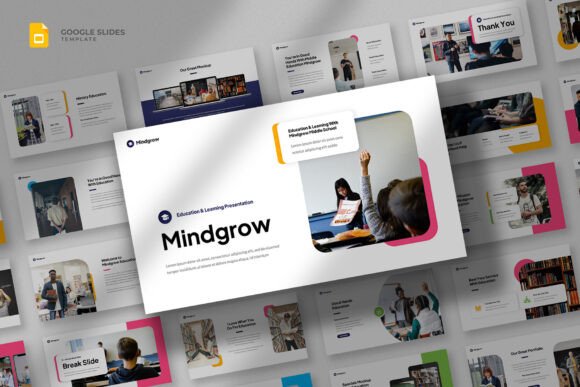
When evaluating options, the Mindgrow - Education Google Slides Template addresses many of these common issues head-on. Designed specifically for academic institutions, schools, universities, and training workshops, it offers a clean, modern aesthetic that aligns with current design trends without sacrificing functionality. With 41 total slides, it covers a wide range of scenarios, from project proposals and portfolio showcases to webinar introductions and course outlines.
What sets this template apart is its flexibility. Unlike rigid designs that force you to conform to a specific layout, Mindgrow features resizable and editable graphics. This means you can adjust diagrams, icons, and infographics to fit your specific data without losing resolution or alignment. Additionally, the inclusion of access to 100 free fonts ensures that your text remains legible and stylistically appropriate for any subject matter, whether it is a scientific seminar or a creative arts workshop.
Avoiding Common Selection Mistakes
Choosing the right template requires more than just picking the one with the prettiest thumbnail. Here are practical steps to avoid common errors when selecting an Education Google Slides Template:
- Check File Compatibility: Ensure the template comes in formats that work for your workflow. Mindgrow includes both Google Slides and .PPTX files, allowing you to collaborate seamlessly in the cloud or present offline using PowerPoint. Always verify this before purchasing to avoid conversion headaches later.
- Verify Editability: Many "premium" templates actually lock critical elements. Before committing, check if the graphics are truly editable vectors or just flattened images. You need the ability to change colors, resize elements, and swap out placeholders easily.
- Review the Slide Count and Variety: A template with only five basic slides might seem simple, but it often lacks the specialized layouts needed for complex topics like data analysis or team introductions. A robust option like Mindgrow provides 41 distinct slides, ensuring you have a dedicated layout for every section of your talk.
- Assess the Documentation: Good products come with clear instructions. Look for included help files, such as README_INFO.txt or HELPFILE.pdf. These documents are invaluable for beginners who may need guidance on how to customize advanced features or troubleshoot minor issues.
The Importance of Professionalism in Academic and Business Settings
In the context of higher education and corporate training, your presentation is a reflection of your institution or brand. A sloppy, disorganized slide deck can suggest that the material itself is unrefined. Conversely, a minimalist and professional design directs the audience's focus entirely to the information being presented. The Mindgrow template achieves this by stripping away unnecessary clutter while maintaining a sophisticated look suitable for everything from a startup pitch deck to a formal company profile.
Consider the scenario of a university researcher presenting at a conference. They have spent years gathering data, but if their slides are hard to read due to low-contrast text or chaotic layouts, their findings may be dismissed. By using a template designed for clarity, they ensure that their hard work gets the attention it deserves. Similarly, a freelancer creating a marketing kit for a client needs to demonstrate competence immediately. A polished, consistent visual identity built on a solid template conveys reliability and expertise.
Maximizing Your Investment
Once you have selected a high-quality Education Google Slides Template, the next step is to use it effectively. Do not simply fill in the blanks; adapt the structure to your narrative. Use the variety of layouts to create a logical flow. For instance, use comparison slides for contrasting theories, timeline slides for historical context, and process slides for explaining methodologies. The 16:9 wide-screen layout included in Mindgrow ensures that your visuals take full advantage of modern display technology, making your charts and images crisp and engaging.
Remember that the images provided in preview galleries are for demonstration purposes only and are not included in the final file. This is a standard practice in the industry, so do not be misled. Instead, plan to source your own high-resolution imagery that aligns with your specific topic. This customization adds a personal touch and ensures that your content remains unique and relevant.
Ultimately, investing in a tool like the Mindgrow - Education Google Slides Template is about saving time and elevating quality. It removes the friction of design decisions, allowing you to channel your energy into crafting compelling stories and delivering impactful lessons. Whether you are teaching a classroom, training a team, or pitching an idea, the right foundation makes all the difference between a forgettable talk and a memorable experience.